Tree Health Failures in Southern California: Why Accurate Diagnosis Is Critical for Preservation, Tree Risk Assessment, and Property Protection
Trees in Southern California exist within highly managed urban and residential environments where natural systems are constantly influenced by human activity. Unlike forests, urban trees in Los Angeles and surrounding areas face continuous stress from development, irrigation systems, soil modification, and climate conditions.
These stressors can be biotic, such as pests and fungal diseases, or abiotic, including soil compaction, drought, overwatering, and construction-related impacts. Over time, these factors contribute to progressive decline, structural instability, and increased risk of failure.
While many trees can tolerate short-term stress, prolonged exposure often leads to deterioration that is not immediately visible. This is where most property owners and project teams underestimate the problem.
Early Signs of Tree Decline Are Often Missed
Early-stage tree stress is subtle and frequently misinterpreted as seasonal change. A tree may appear “slightly off” without raising immediate concern, but this phase is often when intervention is most effective.
Common early indicators include:
Canopy thinning or uneven foliage distribution
Leaf discoloration or premature leaf drop
Reduced growth and seasonal vigor
Minor dieback in upper branches
These symptoms are often dismissed, but they typically signal underlying root stress or systemic imbalance. Waiting too long allows conditions to progress beyond simple correction.
Misdiagnosis: The Most Common and Costly Mistake
Tree health issues in Southern California are rarely straightforward. The same visible symptoms can result from completely different underlying causes, which is why assumptions often lead to poor decisions.
For example, a coast live oak showing canopy dieback might be reacting to drought stress or compacted soil. In those cases, improving irrigation or soil conditions can stabilize the tree. However, the same visual pattern could also indicate Armillaria root rot, a fungal disease that progressively destroys the root system and compromises long-term stability.
A similar pattern exists with ornamental species like liquidambar or pear trees. Premature leaf drop may be caused by irrigation imbalance, but it can also be the result of fungal pathogens that worsen over time. Without proper diagnosis, these distinctions are easy to miss, and treatment efforts may end up ineffective or even harmful.
How Tree Health Problems Escalate Over Time
When tree issues are not properly identified, they tend to worsen quietly before becoming obvious. By the time visible damage appears, the internal condition is often already advanced.
A common example in Southern California is bark beetle infestation in pine trees. These infestations develop internally, and by the time needle discoloration becomes visible, the structural damage is typically severe. At that stage, preservation options are extremely limited.
Another major concern is Phytophthora, a soil-borne pathogen that affects root systems. It can remain undetected while gradually reducing the tree’s ability to absorb water and nutrients. Above-ground symptoms may not appear until the tree is already structurally compromised.
Delayed diagnosis increases the likelihood of failure and introduces avoidable risk to surrounding property.
Construction Damage Is a Leading Cause of Tree Failure
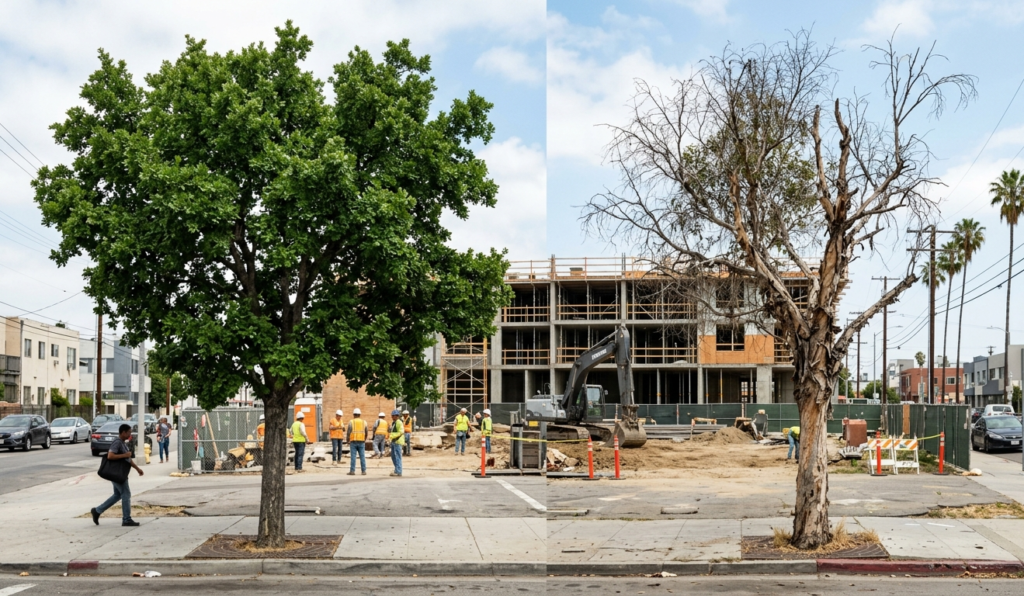
In urban environments like Los Angeles, construction activity is one of the most significant contributors to tree decline. These impacts are often unintentional but have long-lasting effects.
Typical construction-related stressors include:
Soil compaction from equipment or foot traffic
Root damage from trenching or excavation
Changes in grade or drainage patterns
Overwatering or irrigation disruption
Even small intrusions into a tree’s critical root zone can have delayed consequences. Root loss may not show immediate symptoms, but over time it reduces structural support and leads to canopy decline.
Because these effects develop gradually, they are often misattributed to unrelated causes or ignored altogether.
Why Visual Tree Inspections Are Not Enough
Visual assessment is often the starting point in tree evaluation, but it rarely provides enough information for accurate diagnosis. Many internal or root-related issues cannot be identified from appearance alone.
A proper tree risk assessment involves a deeper analysis of multiple factors. These include species behavior, soil conditions, moisture dynamics, and site history, particularly any recent disturbances. In some cases, confirming a diagnosis may require soil testing or laboratory analysis.
Without this level of evaluation, decisions are frequently based on incomplete information. This can result in treatments that fail to address the real issue or lead to unnecessary removal of viable trees.
Professional Arborist Diagnosis and Tree Risk Assessment
A consulting arborist provides a structured approach to identifying and managing tree health issues. Rather than focusing only on visible symptoms, the evaluation is centered on determining the underlying cause of decline.
At California Ecology Arborists, assessments consider both biological and environmental variables to ensure accurate conclusions. This includes evaluating tree stability, identifying disease presence, and understanding how site conditions influence long-term outcomes.
This type of analysis is especially important for construction projects, permitting requirements, and compliance with local regulations. Arborist reports often play a critical role in decision-making and project approval.
Tree Risk, Liability, and Property Value
Tree health is closely tied to property safety and liability. A declining tree is not just a landscape concern, it can become a legal and financial issue if it fails.
Undiagnosed structural weakness may lead to falling limbs or complete tree collapse, potentially causing damage to structures, vehicles, or neighboring properties. In these cases, property owners may be held responsible.
At the same time, removing a tree without proper justification can create its own problems. In Los Angeles, protected tree ordinances may apply, and improper removal can lead to penalties or project delays. It can also negatively impact property value and aesthetics.
Accurate diagnosis ensures that the right decision is made, whether that is preservation, mitigation, or removal.
Conclusion: Early Diagnosis Protects Trees and Property
Tree health issues are progressive, not static. Once decline begins, conditions typically worsen over time, and the window for effective intervention becomes smaller.
Early and accurate diagnosis provides the best opportunity to preserve trees, reduce costs, and prevent risk. It allows property owners and project teams to make informed decisions rather than reactive ones.
If signs of decline are present, professional arborist evaluation should be considered an essential step in responsible property management.