

Los Angeles Tree Regulations: What Contractors Need to Know
When you plan a construction project in Southern California, trees aren’t just part of the scenery. In Los Angeles and many Orange County communities, trees are part of the law. The City of Los Angeles Protected Tree Ordinance (LAMC §46.01) makes it illegal to remove, cut or damage certain native species without a permit. Ignoring these rules can halt your project, expose you to large fines and damage your reputation. This guide explains why staying compliant matters and how to protect yourself from costly violations.
Which trees are protected?
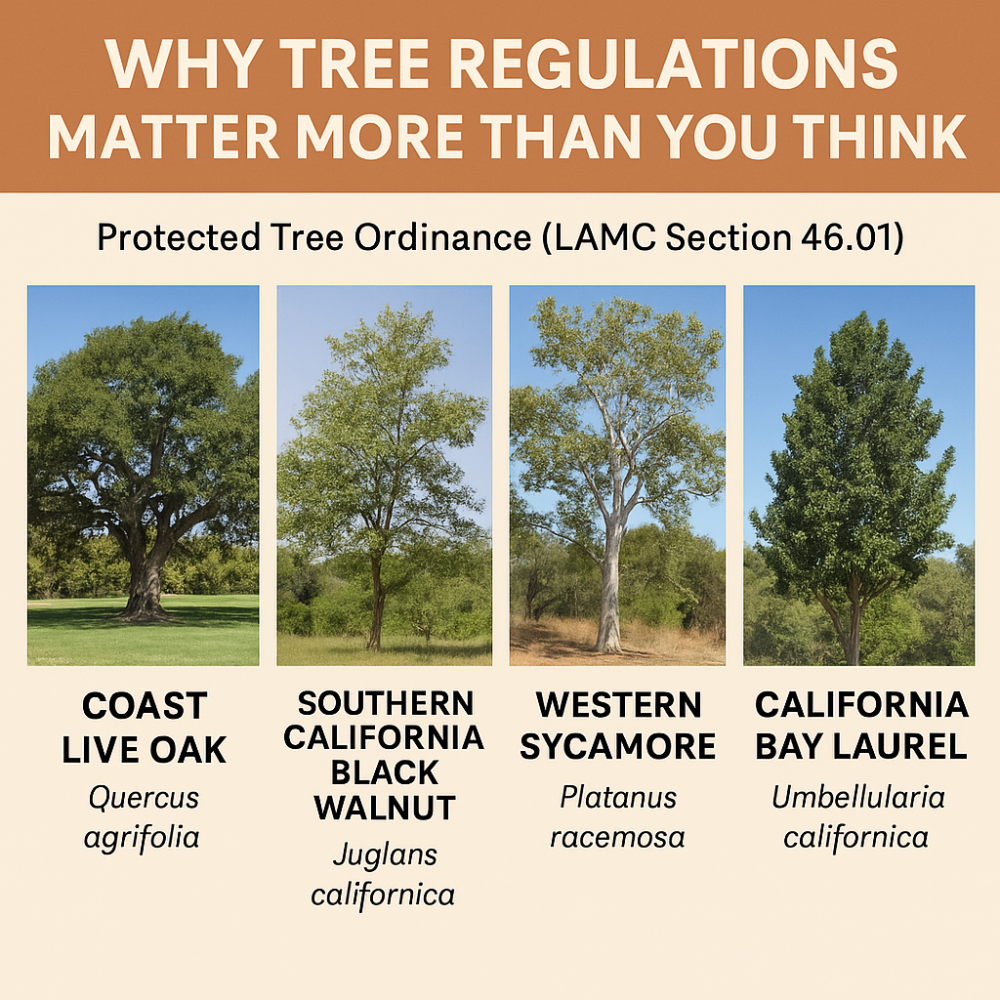
The Los Angeles tree ordinance safeguards four native species. Knowing these species and their requirements is critical for contractors, developers and site managers:
Protected species | Regulatory notes |
Coast Live Oak (Quercus agrifolia) | Requires a tree removal permit in Los Angeles before any cutting, pruning or encroachment. |
Southern California Black Walnut (Juglans californica) | Contractors must obtain an arborist report and follow the Protected Tree Ordinance for any work around this species. |
Western Sycamore (Platanus racemosa) | Often overlooked on job sites; damaging roots during grading or trenching triggers enforcement. |
California Bay Laurel (Umbellularia californica) | Pruning or removal requires a permit; infractions carry fines and replanting requirements. |
Removing or harming these trees without the right approvals can shut down a job site and lead to fines of $10,000 or more per tree. Even routine work, trenching for utilities, grading, staging materials or sustained foot traffic, can cause violations if performed within a protected tree’s critical root zone (CRZ). To avoid being blindsided, contractors should schedule a pre‑construction tree survey and permit‑ready arborist report before mobilizing.
The real cost of non‑compliance
Tree‑related violations are among the most common and costly issues on construction sites in Los Angeles. Fines can exceed ten thousand dollars per tree, and the city can issue stop‑work orders that bring entire projects to a halt for weeks. Contractors may also face mandatory mitigation plans and strict replanting requirements. Beyond the direct costs, non‑compliance leads to frustrated clients, schedule delays and a damaged reputation that can impact future work.
Hidden violations during routine work
Many contractors assume tree protections only cover the area near the trunk and canopy. In reality, the critical root zone typically extends well beyond the canopy edge and is often calculated at 1 to 1.5 feet per inch of trunk diameter. For example, a mature Coast Live Oak with a 24‑inch trunk can have a protected root zone extending 24–36 feet from the base. Activities that appear harmless, like staging equipment, parking vehicles or walking within this zone, can compact the soil and impair root oxygenation. Compaction damage may not become visible for months, but enforcement agencies can trace a tree’s decline back to construction activity and hold the contractor responsible.
Other common triggers for enforcement include:
- Utility trenching: lateral roots often extend beyond the canopy, and severing them during trenching violates the ordinance.
- Grade changes: altering soil levels within the root zone can impact drainage and root depth.
- Unauthorized pruning: trimming or canopy work on a protected tree requires city authorization.
- Material staging: storing equipment or stockpiling materials within the CRZ compacts soil and damages surface roots.
These are routine construction activities, so the risk isn’t obvious unless you deliberately identify protected trees and map their protection zones before work begins.
Why documentation protects you
In many enforcement disputes, the key question isn’t whether damage occurred, it’s whether the contractor can prove that proper precautions were in place. A pre‑construction tree survey, licensed arborist sign‑off, and photographic records of protection measures show that the contractor took tree ordinance compliance seriously. These records often determine whether the city issues a warning or a five‑figure fine. Documentation should be treated as a standard part of pre‑construction planning, not a reactive measure after a problem surfaces.
Permits and hidden requirements
Don’t assume that the permit set tells you everything about tree protection. Requirements may be found in municipal ordinances, conditions of approval, homeowner association covenants or environmental mitigation measures that aren’t reflected on construction drawings. Infill and redevelopment projects may involve older trees with heritage or landmark designations. Contractors should research all applicable regulations and consult an ISA Certified Arborist to ensure the tree protection plan meets city standards.
How CalEco Arborists helps contractors
Navigating Los Angeles tree regulations can be daunting. That’s where CalEco Arborists come in. Our team of ISA Certified Arborists works directly with contractors and project managers to:
- Identify protected trees and map their critical root zones before construction begins.
- Produce permit‑ready arborist reports that the city approves on the first submission, saving time and money.
- Monitor construction sites to prevent violations, including soil compaction and unauthorized pruning.
- Negotiate mitigation strategies that align with your schedule and budget if a violation occurs.
We speak the city’s language and know how to keep your job moving. Our team stays up to date on the latest local ordinances and can guide you through the Los Angeles tree removal permit process, ensuring that your project complies with all requirements.
Key takeaways for contractors
- Know the rules: Understand which species are protected and the extent of their critical root zones.
- Plan ahead: Hire an arborist to conduct a tree survey and secure required permits before mobilizing.
- Protect the root zone: Avoid trenching, grading, vehicle access and material staging within the CRZ.
- Document everything: Keep written and photographic records of protection measures.
- Consult experts: Partner with CalEco Arborists for permit‑ready reports, site monitoring and mitigation plans.
Following these steps will help you comply with the Los Angeles Protected Tree Ordinance, avoid costly fines and keep your project on schedule. If you need assistance with tree ordinance compliance, permits or on‑site monitoring, contact CalEco Arborists today via CalEcoArborists.com