White Fungal Growth on Trees: What It Means and When to Take Action
White fungal growth on trees is one of the most alarming signs property owners notice in Southern California. It often appears suddenly and can raise immediate concerns about tree health, safety, and potential removal. While some fungal growth may be harmless at the surface level, in many cases it signals deeper structural or biological issues that require professional evaluation.
Understanding what white fungus means and how it affects a tree is critical for making the right decision. Misinterpreting these signs can lead to unnecessary removal or, more importantly, overlooking serious internal decay.
At CalEco Arborists, fungal growth is evaluated as part of a comprehensive tree health assessment to determine whether the issue is cosmetic or a sign of structural risk.
What Causes White Fungal Growth on Trees
Fungal growth develops when moisture, organic material, and environmental conditions create an ideal environment for spores to grow. In Southern California, irrigation practices, shaded areas, and decaying wood often contribute to fungal presence.
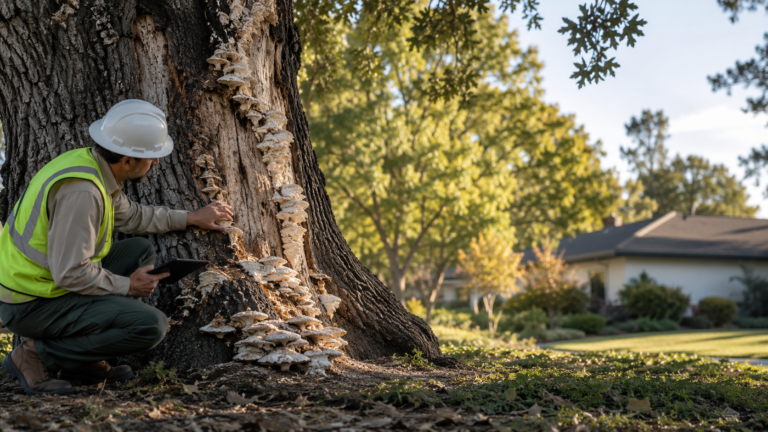
White fungus typically forms on bark, branches, or near the base of the tree. While it may appear external, it is often connected to internal processes occurring within the tree. In many cases, fungi are feeding on dead or decaying wood, which can indicate that parts of the tree are already compromised.
This is why visible fungal growth should never be ignored. It is often a symptom rather than the root cause of the problem.
Types of White Fungal Growth
White fungal growth can take several forms, each with different implications for tree health. Some fungi appear as powdery coatings on leaves or bark, while others form shelf like structures on the trunk. There are also cases where white mold or soft growth develops in shaded or damp areas.
Surface level fungi may be related to environmental conditions such as humidity or poor airflow. However, more structured growth, especially on the trunk or major branches, is often associated with wood decay. These fungi break down the internal structure of the tree, reducing its strength over time.
Distinguishing between harmless surface fungus and decay related fungi requires professional evaluation.
What White Fungus Indicates About Tree Health
The presence of white fungus often indicates that the tree is under stress or already experiencing internal decline. In many cases, fungal growth is associated with decaying wood, which means that part of the tree’s structure has begun to break down.
This does not always mean the entire tree is failing, but it does signal that further inspection is necessary. A tree may still have healthy sections while other areas are compromised. The key is determining how extensive the decay is and whether it affects structural stability.
Fungal growth can also be linked to root issues, especially when it appears near the base of the tree. Root decay weakens the foundation, increasing the risk of instability or failure.
When White Fungus Becomes a Safety Risk
One of the most important concerns with fungal growth is its impact on structural integrity. As fungi break down wood fibers, the tree becomes weaker from the inside. This can lead to hidden defects that are not visible externally.
Over time, this weakening increases the likelihood of branch failure or complete tree collapse. Trees with advanced decay may appear stable but can fail suddenly, especially during wind or environmental stress.
In Southern California, property owners can be held liable if a tree failure causes damage and it is determined that the issue could have been identified earlier. This makes early evaluation essential for both safety and risk management.
Common Misconceptions About Tree Fungus
Many property owners assume that all fungus is harmful or that removing the visible growth will solve the problem. In reality, fungus is often only a symptom of a deeper issue. Removing it does not address the underlying cause.
Another common misconception is that a tree with fungus must be removed immediately. While this may be true in cases of advanced decay, many trees can be preserved if the problem is identified early and managed properly.
Understanding the role of fungus in the ecosystem is important, but so is recognizing when it indicates a structural concern.
The Importance of Accurate Diagnosis
Because fungal growth can vary widely in severity, accurate diagnosis is essential. A professional arborist evaluates not just the visible fungus, but also the overall condition of the tree.
This includes assessing structural integrity, identifying areas of decay, and determining whether the fungus is affecting critical parts of the tree. Soil conditions, irrigation patterns, and environmental factors are also considered, as they often contribute to fungal development.
At CalEco Arborists, this process ensures that recommendations are based on data rather than assumptions. Whether the solution involves monitoring, treatment, or removal, it is guided by a clear understanding of the tree’s condition.
Treatment and Management Options
Managing fungal growth depends on the underlying cause and the extent of the issue. In cases where fungus is related to excess moisture, improving drainage and adjusting irrigation practices can reduce conditions that support growth.
When decay is present, the focus shifts to evaluating structural risk. This may involve pruning affected areas, reducing weight on compromised branches, or implementing measures to stabilize the tree.
In more advanced cases, where structural integrity is significantly compromised, removal may be necessary to eliminate safety risks. The key is determining the appropriate course of action based on accurate evaluation.
Long Term Prevention Strategies
Preventing fungal growth begins with maintaining overall tree health. Healthy trees are more resistant to decay and less likely to develop conditions that support fungal growth.
Consistent irrigation practices that avoid overwatering help prevent excess moisture in the soil. Proper pruning improves airflow and reduces shaded areas where fungus can develop. Soil management supports root health and strengthens the tree’s natural defenses.
Regular tree inspections are one of the most effective ways to prevent problems from developing unnoticed. Early detection allows for intervention before fungal growth becomes a structural concern.
When to Work With a Consulting Arborist
If white fungal growth is present on a tree, professional evaluation is the safest approach. A consulting arborist can determine whether the fungus is superficial or a sign of internal decay, and provide clear recommendations based on the findings.
This is particularly important for properties where trees are located near structures, walkways, or high traffic areas. In these situations, understanding the level of risk is essential.
At CalEco Arborists, our assessments are designed to provide clarity and confidence in decision making, ensuring that trees are managed safely and effectively.
Why Choose CalEco Arborists
CalEco Arborists specializes in consulting based tree care focused on accurate diagnosis and risk management. Our approach is built on understanding the relationship between visible symptoms and underlying conditions.
We provide detailed tree health assessments, decay evaluations, and arborist reports that support both preservation and safety. Every recommendation is based on a thorough analysis of the tree and its environment.